
by Bryan Chua
Singtel bought its way into seven markets. Notion let users invite their friends. One writes cheques. The other ships features. Stand far enough back and you realise both are running the same machine — just with different instruments bolted onto the front.
Growth is never accidental. It is always engineered. The question is only which lever you are pulling.
The Singtel story reads like a chess board. Stakes in Airtel, Telkomsel, Globe, AIS, Optus. Technology layers laid on top through NCS and Optus Enterprise. Venture bets routed through Innov8 — Trustwave, Amobee, a string of cloud and AI adjacencies. The moat is structural: 700 million subscribers sitting under one Group-level P&L. No amount of organic marketing gets you that footprint. You have to buy it.
The Notion story reads like a growth curve. A free tier generous enough that students build their second brains on it. Shared pages that quietly double as sales demos. A public template gallery where superusers do the marketing. Every time a team creates a database, invites a collaborator, or ships a public doc, the system gets a little stickier, a little more entangled with the way that team thinks.
Two very different motions. Same underlying move.
What does it mean to engineer a business?
Engineering, in the business sense, is not about code. It is about designing a system whose outputs compound without linear effort. Three flavours matter:
Technology engineering is the one most people think of first — building the systems, the data pipelines, the infrastructure. It is necessary, but it is always a means to an end. A telco with excellent engineering and no subscribers is a very well-run museum.
Business engineering is the discipline of owning market structure. You use capital, equity, partnerships, and M&A to shape the competitive landscape before the race even starts. You don’t win customer by customer — you win by owning the pipes the customers flow through.
Product engineering is the discipline of owning the user’s workflow. You use free tiers, activation loops, embedded sharing, and virality to embed yourself in the way work gets done. You don’t sign contracts — you become muscle memory.
The distinction matters because each flavour has its own physics. Business engineering is slow, expensive, and high-stakes. Product engineering is fast, cheap, and requires relentless iteration. But the logic at the top is identical: design a system where every move makes the next move easier.
Singtel’s playbook: owning the pipes
Singtel does not think in MAUs. It thinks in market coverage. Regional telco stakes give it structural presence in Southeast Asia and India — geographies where organic growth would take decades. Technology service layers like NCS and Optus Enterprise sit on top of that base, selling integration, cloud, and managed services back into the same markets Singtel already owns infrastructure in. Innov8, the corporate venture arm, places smaller bets on adjacencies — cybersecurity, ad-tech, AI — that can plug back into the main business if they pay off.
The growth signal is not Net Promoter Score. It is ARPU, subscriber count, market share, and enterprise contract value. These are slow-moving, capital-intensive numbers. You don’t A/B test your way to a stake in Airtel. You negotiate, you write cheques, you wait.
Capital buys you a position that no amount of product iteration can replicate. But only if you have a plan for what to do once you own it.
This is the trap. Business engineering without product engineering produces sprawl — a federation of assets that don’t talk to each other, don’t share a customer graph, and don’t compound. The moat exists, but the water evaporates.
Notion’s playbook: owning the workflow
Notion’s wedge is the free tier. Not free as a pricing tactic — free as a distribution strategy. Every free user is a demo. Every shared page is a billboard. Every template posted to the public gallery is an outbound motion that the company did not have to fund.
The signals Notion watches replace the traditional top-of-funnel. Database creation rate. Invite acceptance. Daily active usage inside a workspace. When a team hits a certain threshold of pages, blocks, and shared docs, something flips — Notion stops being an app and becomes the company’s institutional memory. That is the real switching cost. Not the export format. Not the API. The fact that half your team’s brain is now shaped by the tool.
Product engineering of this kind is cheap to start and brutal to scale. You can launch a better editor in a weekend. You cannot manufacture the years of user habit that turn a note-taking app into a workspace.
The uncomfortable truth
Look past the optics and Singtel and Notion are playing the same four-move game.
Same lock-in logic, different mechanism. Singtel locks in through infrastructure ownership and enterprise contracts. Notion locks in through workflow dependency and institutional memory. Both end in the same place: a customer for whom leaving is more expensive than staying.
Same expansion signal, different metric. Singtel tracks subscribers, ARPU, enterprise seats. Notion tracks workspaces, invites, daily actives. Both are counting depth of penetration into the customer’s life — one through the wallet, one through the calendar.
Same new-market entry move, different instrument. Singtel enters a market by buying a local operator. Notion enters a market by releasing a free tier and watching who bites. The capital cost is vastly different. The underlying bet — plant a flag, then expand — is identical.
Same failure mode: fragmentation without integration. A telco conglomerate with no group-level data strategy is a holding company pretending to be a platform. A product suite with no account-level story is a collection of nice apps pretending to be a system. Both die the same way — by sprawling faster than they compound.
What each can learn from the other
Singtel’s blind spot is product signal thinking. Its enterprise services arms sell like traditional telcos — long procurement cycles, relationship selling, master agreements. But the people buying cloud, cybersecurity, and AI today behave like product users. They want to try before they buy, see activation within a week, and expand on evidence. Singtel needs to learn the grammar of PLG, or watch its enterprise wallet share migrate to vendors who speak it natively.
Notion’s blind spot is business engineering. As it scales into the enterprise, the game changes. Procurement cares about security reviews, not templates. Channel partners, systems integrators, and strategic investments start to matter more than virality. The same acquisition tactics that got Notion to a million teams will not get it embedded in the Fortune 500. At some point, every great product company has to learn to write cheques.
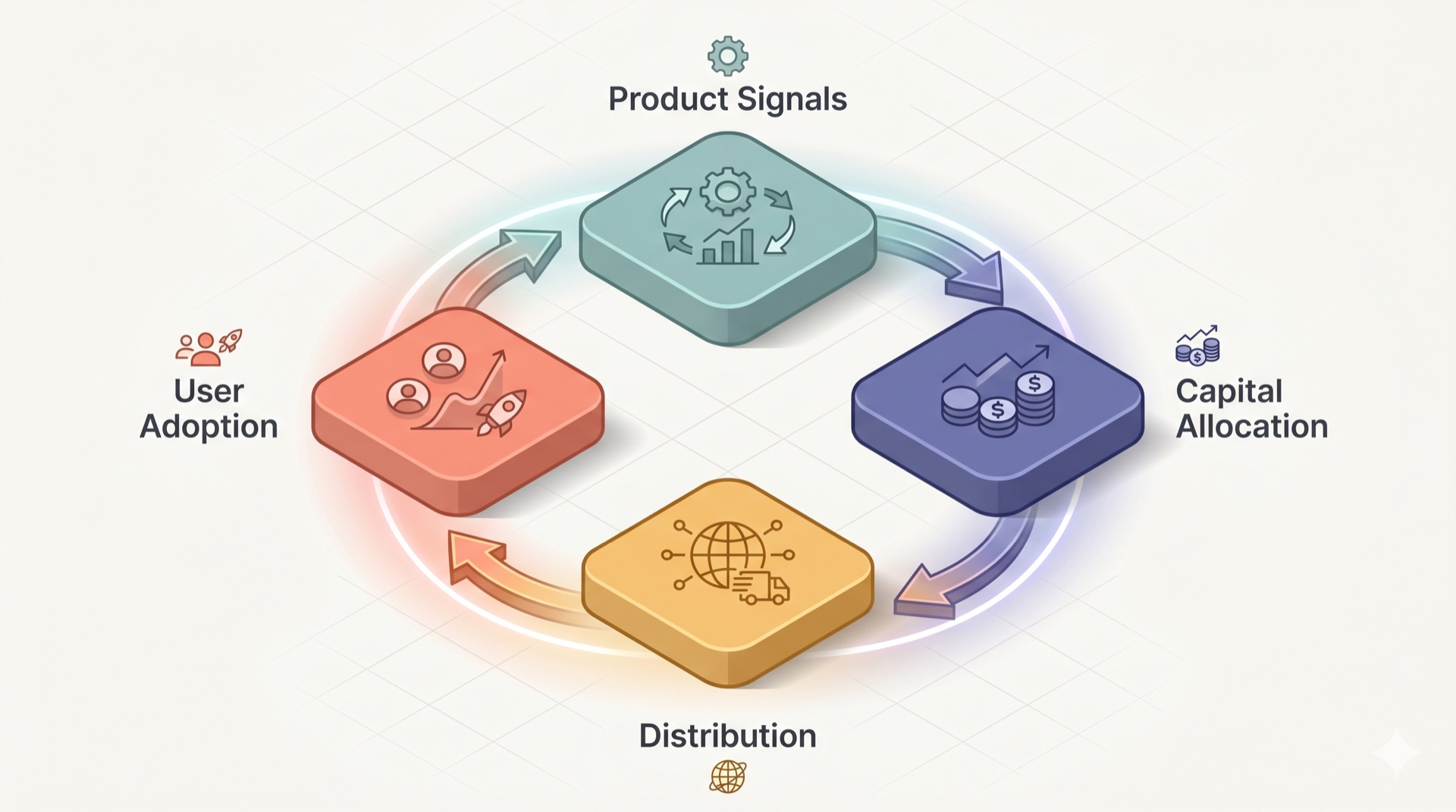
The compounding machine
The instinct is to pick a side. Pick the telco model or the SaaS model. Pick capital or product. The companies that actually win refuse the binary.
Product signals tell you where to place capital. Capital unlocks distribution that product alone cannot reach. Distribution creates surface area for more product signals. The loop closes.
That is the machine. Singtel’s next decade depends on whether it can read product signals well enough to direct its capital intelligently — away from dying assets, toward compounding ones. Notion’s next decade depends on whether it can engineer the business side — partnerships, acquisitions, enterprise motion — without losing the product instinct that got it here.
Two roads. One destination. The companies that engineer the feedback loop between product and capital don’t just grow. They compound — and compounding, given enough time, looks a lot like winning.